
Abdul Seckam1 PhD, Stephen Mitchell2 MA MB FRCS(Urol) PhD, Heidi V Tempest3 MA MB FRCS(Urol) MD
1Head of Research and Academia, Healthcare Business Solutions (UK) Ltd. email – Abdul.Seckam@hbsuk.co.uk 
2Consultant Urological Surgeon, Governance Lead for Urology, Buckinghamshire Hospitals Trust
3Consultant Urological Surgeon, Oxford University Hospitals


Introduction 

Previously, the authors noted that technological advances have transformed urology, giving examples of where these have enhanced diagnosis, treatment, and patient care (Seckam and Mitchell, 2025). The highlighted innovations included robotic-assisted surgery, high-resolution imaging, flexible endoscopy, telemedicine, laser therapies, and three-dimensional printing. It was also suggested that, while these improvements can benefit outcomes and access, challenges such as digital literacy and technology acceptance need to be addressed to ensure equitable care and successful implementation (Seckam, 2023; Moulaei and Kazemi-Arpanahi, 2025; Seckam and Mitchell, 2025). 
 
A study by Okoye et al (2024), based in Seattle, demonstrated that telemedicine can significantly reduce patient travel burdens, with estimates indicating average savings of 145 miles and 179 minutes per virtual appointment, which helps decrease travel time for patients and allows access across large geographical areas.  
 

Benefits and challenges of using teleurology

A scoping review by Moulaei and Kazemi-Arpanahi (2025) examined the applications, benefits, and challenges of adopting teleurology. After their initial search and screening, 49 articles were selected for data extraction. From these articles, the authors identified 216 benefits and 123 challenges for teleurology, with 28 benefits and 13 challenges remaining after consolidation into related themes. n indicates the number of articles which identified the specific benefit or challenge. 
 

Benefits

‘Reducing patient treatment expenditures, travel costs and time’ (n=30), ‘Increasing patient satisfaction with telemedicine services’ (n=23), ‘Access to care for patients in rural or underserved areas’ (n=17), and ‘Curbing disease spread and maintaining care during pandemics while respecting social distancing’ (n=17) were considered to be the most common benefits of teleurology. 
 

Challenges

The challenges included: ‘Lack of physical examination of patients during telemedicine visits’ (n=30), ‘Need for robust digital infrastructure (inaccessible to technology, computer and internet)’ (n=23), and ‘Patient concerns about confidentiality and privacy’ (n=18). 
 
These benefits and challenges align with the findings of previous research (Smith et al, 2020; Naik et al, 2022; Lundon, 2023; Moulaei et al, 2023; Okoye et al, 2024; Almuhaideb et al, 2025). Furthermore, it has been suggested that teleurology offers positive implications such as cost savings, enhanced patient satisfaction, and improved access (Okoye et al, 2024; Moulaei and Kazemi-Arpanahi, 2025). Conversely, issues like the need for physical examination (Naik et al, 2022) and lack of digital equity (Smith et al, 2020; Almuhaideb et al, 2025) continue to present challenges (Moulaei and Kazemi-Arpanahi, 2025).
 

A digital platform for urology 

Healthcare Business Solutions (UK) Ltd offers a digital urology service which is modelled on the established pattern of outpatient consultations. Questionnaire sets have been designed for the most common outpatient presenting complaints, such as lower urinary tract symptoms, recurrent urinary infections, scrotal lumps, erectile dysfunction and renal stones. 
 
The question sets were designed incorporating both National Institute for Health and Care Excellence or European Association of Urology guidelines, so each question set gives the reviewing clinician the important positive or relevant negative history. The completed review gives the clinician a comprehensive ‘clerking’ of the patient before the appointment, providing a quick and efficient summary of the presenting issue. This system has a number of advantages:
  1. The questionnaire can be completed at the patient’s convenience, at their own pace and from any location which can reduce stress and allow for more thoughtful responses
  2. Patients can also provide information outside traditional office hours, giving them more freedom. Allowing patients to provide information asynchronously gives them more autonomy and flexibility, which can improve response rates and reduce the burden of scheduling
  3. The questions allow for an up-to-date history to be taken which may have changed since referral
  4. ‘Red flag’ alerts are included which identify urgent or time-sensitive conditions 
  5. The digital urology service delivers standardised, consistent questions every time. This reduces inter-clinician variability that can affect data quality and reliability, supports adherence to clinical guidelines, and enhances comparability across patients
  6. Clinicians review questionnaire responses remotely, which facilitates more flexible working and a greater available workforce, such as retired or part-time clinicians
  7. Clinician review can be performed by the Trust’s own clinicians, or clinicians working for Healthcare Business Solutions (UK) Ltd which means that the system can be used in departments where insufficient workforce is a problem
  8. The digital urology service also has environmental benefits – it can contribute to organisational sustainability goals by reducing paper use, postage, and printing, as well as decreasing the need for in-person appointments and associated patient and staff travel. Digital-first data collection aligns with NHS and wider healthcare net zero strategies by lowering the overall carbon footprint of routine clinical processes as outlined in the Healthcare Business Solutions (UK) Ltd (2025a) white paper.  

Feedback on the system is obtained from patients and some cases are audited internally for quality purposes. 

Case study: Integration of digital urology services at North Cumbria Integrated Care NHS Trust 

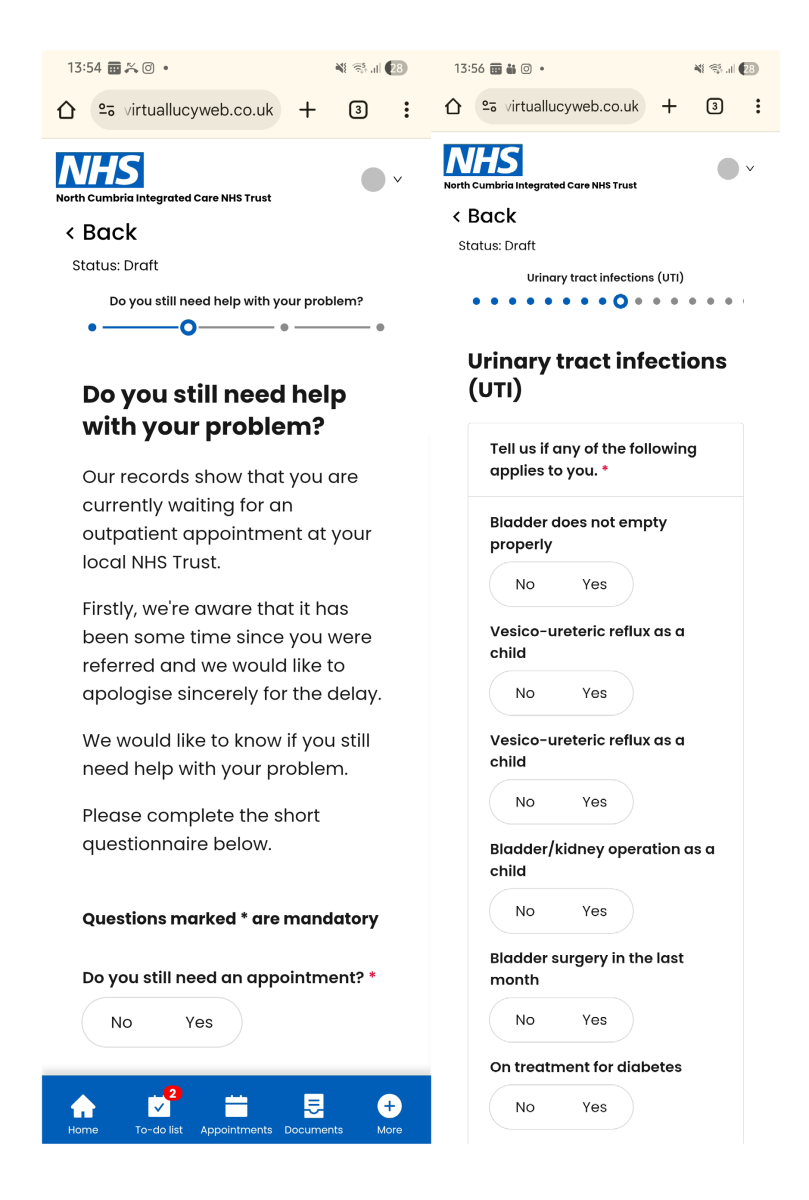
Healthcare Business Solutions (UK) Ltd collaborated with North Cumbria Integrated Care NHS Trust to provide a digital urology service from June to November 2024, to address a backlog of 1279 patients waiting for urology assessment (Healthcare Business Solutions (UK) Ltd, 2025b) (Figure 1). 

Patients who were directed to this digital system had been waiting times for a face-to-face appointment ranging from 32 to 65 weeks. The Healthcare Business Solutions (UK) Ltd urology digital pathway was fully integrated with North Cumbria Integrated Care NHS Trust systems to improve the patient experience and streamline administrative processes. Patients completed structured online questionnaires, which were jointly reviewed by Healthcare Business Solutions (UK) Ltd and North Cumbria Integrated Care NHS Trust consultants. This enabled the development of appropriate care plans without the need for outpatient appointments. 

As with any new system involving IT, some patients could not or did not want to use the system, for reasons including caution, lack of access to technology and the level of digital literacy of the population. In this case study, nearly 40% of patients didn’t use the system (higher than the usual rate of about 25%), which the authors believe is in part a result of differing patient demographics and in part because this was their first digital urology contract so it provided lessons for the providers and the client in terms of supporting patient engagement.  
 
Despite this, key outcomes from this initiative include:
 
  • 454 patients (35%) achieved a clock stop outcome (administrative status used to mark the end of a patient’s waiting time for treatment
  • 354 patients (28%) were discharged without further intervention
  • 13 patients were identified for urgent referral under the ‘two-week wait’ cancer pathway
  • A positive patient-reported experience measures (PREMs) score of 4.33 out of 5 was recorded.
     
This integration demonstrated the potential of digital health solutions to improve service delivery, reduce waiting times, and support clinical decision-making in urology.


Figure 1. Example screenshots from the Healthcare Business Solutions (UK) Ltd urology digital pathway used with North Cumbria Integrated Care NHS Trust. 

Conclusions 

This article outlines the case for digital urology services, highlighting the benefits and challenges. Future research should be conducted to address these challenges, to assess how digital urology services can enable efficacy, safety, and high-quality care. 

References

Almuhaideb M, Bandaru D, Chawareb EA, Yafi FA, Hammad MAM (2025) Ethical perspective on telemedicine usage in sexual medicine: A friend or a foe? UroPrecision. 3:47–53. https://doi.org/10.1002/uro2.111
Healthcare Business Solutions (UK) Ltd (2025a) Digital Healthcare and Insourcing’s Role in Achieving the NHS Net Zero Target: HBSUK Perspectives. https://www.hbsuk.co.uk/sustainability-whitepaper/ (accessed 23 December 2025)
Healthcare Business Solutions (UK) Ltd (2025b) How online assessments drove a 35% reduction in urology waiting lists. https://www.hbsuk.co.uk/case-studies/ncic-urology/ (accessed 12 December 2025)
Lundon D (2023) Telehealth in Urology. https://doi.org/10.1016/C2020-0-04179-4 (accessed 12 December 2025)
Moulaei K, Kazemi-Arpanahi H (2025) Applications, benefits, and challenges of adopting teleurology: a scoping review. World J Urol. 43(1):330. https://doi.org/10.1007/s00345-025-05706-1 
Moulaei K, Sheikhtaheri A, Fatehi F, Shanbehzadeh M, Bahaadinbeigy K (2023) Patients' perspectives and preferences toward telemedicine versus in-person visits: a mixed-methods study on 1226 patients. BMC Med Inform Decis Mak. 23(1):261. https://doi.org/10.1186/s12911-023-02348-4 
Naik N, Nandyal SR, Nayak SG et al (2022) Telemedicine and telehealth in urology: uptake, impact and barriers to clinical adoption. Front Surg. 9:911206. https://doi.org/10.3389/fsurg.2022.911206 
Okoye F, Gadzinski AJ, Sekar R et al (2024) Telemedicine for multidisciplinary urologic cancer care: a prospective single institution study. Clin Genitourin Cancer. 22(3):102058. https://doi.org/10.1016/j.clgc.2024.02.009 
Seckam A (2023) Does digital health revolutionise medical practice? J Commun Nurs. 37(4):22-23 
Seckam A, Mitchell S (2025) Technological developments in urology. https://www.ucc-today.com/journals/issue/launch-edition/article/technological-developments-in-urology (accessed 12 December 2025)
Smith AC, Thomas E, Snoswell CL, Haydon H, Mehrotra A, Clemensen J, Caffery LJ (2020) Telehealth for global emergencies: Implications for coronavirus disease 2019 (COVID-19). J Telemed Telecare. 26(5):309-313. https://doi.org/10.1177/1357633X20916567